Why Fear of Panic Is the Real Problem — Not Driving

If you struggle with driving anxiety or panic attacks while driving, it can feel obvious what the problem is.
It must be the motorway.
Or traffic.
Or bridges.
Or being stuck in the car.
Or maybe it’s just driving itself.
But if you look a little closer at what’s actually happening internally, something more specific often appears underneath all of that:
You’re not only afraid of driving. You’re afraid of what might happen to you while you’re driving.
And more precisely:
You’re afraid of panic itself.
This distinction might sound subtle, but it changes everything. Because when fear becomes centred around panic rather than driving, the entire experience shifts — emotionally, physically, and mentally.
And importantly, it also explains why so many intelligent, self-aware women feel stuck despite fully understanding that they are safe.
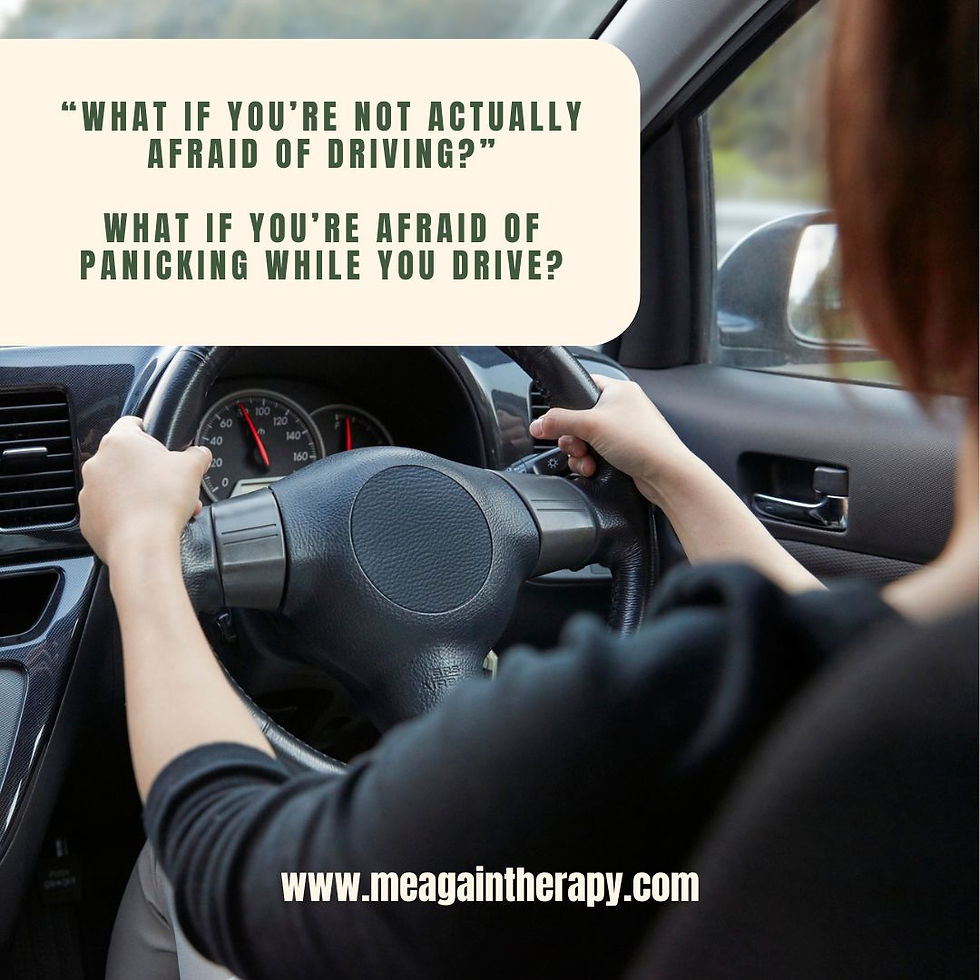
The real fear underneath driving anxiety
Most people assume driving anxiety is about external danger.
But for many women, especially those who have experienced panic before, the fear becomes internal.
It becomes about:
What if I panic again?
What if I can’t stop it?
What if I lose control of my body?
What if it happens and I can’t escape?
What if I feel trapped and it escalates?
So the fear is no longer just about the road.
It becomes about:
the possibility of panic happening inside the experience of driving
And once that shift happens, driving stops feeling like a neutral activity.
It starts feeling like a potential trigger for something overwhelming.

Why panic feels so powerful
Panic is not just anxiety at a higher level.
It has a different quality.
If anxiety says:
“Something bad might happen.”
Panic says:
“Something is happening right now — and I need to act immediately.”
That sense of immediacy is what makes panic feel so convincing.
Your body can suddenly shift into:
rapid heartbeat
tight chest
dizziness
breathlessness
shaking
feeling unreal or detached
urgency to escape
And in that moment, the mind often tries to explain what’s happening:
I’m going to faint.
I’m going to lose control.
I can’t breathe properly.
I need to get out of here.
But what’s actually happening is not necessarily danger — it’s activation.
Your nervous system has switched into a survival response.
The problem is not the activation itself. The problem is what it gets interpreted to mean.
The shift from “driving fear” to “panic fear”
At the beginning, someone might say:
“I’m nervous about driving on motorways.”
But over time, especially after a panic experience, something subtle changes.
The fear becomes:
“What if I panic on the motorway?”
And that one shift is everything.
Because now the feared outcome is no longer:
traffic
roads
speed
or driving itself
It becomes:
your internal experience
Specifically:
panic sensations
loss of control
inability to escape the feeling
fear of escalation
This is why people often begin avoiding not just driving, but:
motorways
tunnels
bridges
busy roads
unfamiliar routes
driving alone
being “too far” from safety
Not because those things are inherently unsafe.
But because they feel like situations where:
“If panic starts, I won’t be able to cope.”

Why fear of panic keeps the cycle alive
When the main fear becomes panic itself, a very specific loop often develops.
It looks like this:
You anticipate driving
You begin monitoring how you feel
You notice normal sensations (heart rate, tension, alertness)
Your mind interprets them as early signs of panic
Anxiety rises
Your body becomes more activated
The sensations intensify
You interpret that as confirmation: “It’s happening”
Panic escalates or feels imminent
Avoidance or escape follows
And here’s the key point:
You are no longer reacting to the road — you are reacting to the possibility of your own response.
This is why reassurance often doesn’t fully resolve the issue.
Because the fear is not:
“Is the road safe?”
It is:
“What if I panic again and can’t handle it?”
Why logic alone doesn’t break this pattern
Many women experiencing driving anxiety are highly intelligent, analytical, and self-aware.
They often already know:
I’m not in danger
This is anxiety
I’ve felt this before and I was fine
It will pass
And yet the body still reacts.
That creates a painful contradiction:
Mentally safe — physically alarmed
This is one of the most confusing aspects of panic.
But it makes sense when you understand this:
Panic is not purely logical.
It is a learned nervous system response.
That means it doesn’t always update through reasoning alone.
It updates through experience, repetition, and recalibration of the body’s threat system.
So even when your mind is calm and rational, your body may still be operating on an older pattern:
“Driving = potential panic = danger”
Why fear of panic is actually the core issue
When we step back, something becomes clear:
For most people with driving anxiety and panic, the deepest fear is not:
crashing
traffic
being stuck in a car
or driving itself
It is:
losing control of internal experience in a situation where escape feels difficult
That is the real trigger.
Which is why someone can feel perfectly fine:
as a passenger
on quiet roads
in familiar environments
…but feel overwhelmed when:
on motorways
in traffic jams
in situations where stopping feels difficult
or when alone in the car
Because those situations amplify one thing:
the fear of not being able to get away from panic
The trap: trying to eliminate panic entirely
One of the most understandable responses is:
“I just need to make sure I don’t panic.”
But this is where the cycle can unintentionally tighten.
Because the more panic becomes something you must prevent at all costs, the more your system begins to monitor for it.
And monitoring creates:
tension
hyper-awareness
symptom scanning
increased sensitivity to normal sensations
Which ironically makes panic more likely.
So the goal becomes:
Not “I must never panic” but “I can handle the sensations even if they arise”
That shift alone begins to reduce the fear loop.
What actually helps shift this pattern
When fear of panic is the core issue, change usually comes from a different level than logic alone.
It involves helping the nervous system relearn:
sensations are not danger signals
activation is not loss of control
discomfort does not equal catastrophe
panic feelings are temporary, not threatening
escape urges are part of the response, not instructions
This is why many people find that deeper approaches — including nervous-system based work and hypnotherapy — can be helpful.
Because the focus is not just understanding the fear.
It is changing the emotional and physiological response underneath it.
You are not scared of driving — you are trying to avoid a feeling
This is the most important distinction.
For many people, driving is not the true fear.
Driving is the context in which a feared internal experience might happen.
And that experience is:
panic
So the real question is not:
“How do I become confident driving?”
It becomes:
“How do I stop fearing what happens inside me when I drive?”
Because when that internal fear reduces, the external behaviour naturally changes.

You don’t have to keep organising your life around panic
If you’ve started:
avoiding certain routes
planning life around “safe” driving conditions
needing reassurance before journeys
or feeling limited by where you can go
it can feel like your world is quietly shrinking.
But this pattern is not fixed.
It is learned.
And anything learned can be unlearned.
Not through forcing confidence.
Not through pushing through endlessly.
But through changing your relationship with the internal fear response itself.
Ready to feel calm, confident and free again?
If you recognise that your real fear isn’t just driving — but the possibility of panic while driving — you are already identifying the key piece of the pattern.
And that awareness matters.
Book an exploration call with a leading hypnotherapist specialising in driving anxiety and panic to explore what’s really driving the fear, and what your next step could look like toward feeling calm, capable, and free again behind the wheel.
Because freedom doesn’t come from eliminating every feeling.
It comes from no longer fearing them


Comments